
The story of Mary Seacole is a fantastic example of women making their way through extraordinary circumstances in the 19th century. Born Mary Jane Grant in 1805 to a Scottish army father and a Creole ‘doctress’ mother, she is famous for using her medical skills to help wounded soldiers during the Crimean war. These skills were gained through years of experience in Jamaica and on her travels. For example, she spent time in the mid-1820s visiting British military hospitals in the Caribbean and she learned ways of effectively treating cholera having lived through the 1850 outbreak in Jamaica.
Her reception at the time and through history is often compared with that of Florence Nightingale, particularly because of how, until comparatively recently, she was much less likely to be remembered.
What’s the connection with Norwich?
Mary Seacole’s connection with Norwich comes from her husband, Edwin Horatio Seacole who was born in Norwich. However, having married in 1836, he died after 8 years of marriage. They didn’t have children.
Seacole came to fame thanks to her book Wonderful Adventures of Mrs Seacole in Many Lands. This was published in 1857 after she returned from the war and was an almost immediate bestseller.
But who published her book and what might this tell us about the 19th century world of print?
Mary Seacole’s autobiography was written at a time in her life when she had returned from the Crimea, low on funds as a result of the quick withdrawal of British troops from the area. Much of her stock had had to be sold at loss and there are accounts of her trying to sell remaining goods to wealthy local Russians before she left.
She needed a way to support herself. Already well-known and respected thanks to letters home from the soldiers she had nursed and war time reporting in newspapers like The Times, a book about her experiences was not only an opportunity to tell her own story, but could also hopefully make money from the sales.
Were there any black publishers in 19th century Britain?
Mary Seacole is known as the first black woman to have published her own autobiography but we do know about other black writers and publishers at the time. One notable example is Samuel Jules Celestine Edwards (1857?–1894), who was the son of liberated West Indian enslaved people. Born in Dominica, he is known as the first black British newspaper editor.
Who was James Blackwood?
The book was published by James Blackwood and Co of Paternoster Row in London. This area was well connected with the book trade, described by Charles Dickens as ‘the literary heart of London’. James Blackwood was a descendent of the Scottish publisher William Blackwood, though he had no connection with publishers William Blackwood and Sons.
How was the book printed?
Mary Seacole’s book was printed by Thomas Harrild of 11 Salisbury Square, off Fleet Street. He was a member of the Harrild family, which was famous for manufacturing iron printing presses and other equipment at this period. The Norwich Printing Museum has a Harrild guillotine in the collections. Below you can see an image of a Harrild chase, a heavy steel frame used to enclosed the type in a letterpress forme.


Their major contribution to the industry was from Robert Harrild (1780-1853) who pioneered rollers for inking printing plates. Interestingly, in 1809 their business was first established at Fleet Works, Norwich Street in London. However, ten years later, they moved to 20 Great Eastcheap near St Paul’s, in the historic centre of the printing world.
The process would have been letterpress from hand-set type with wood-engraved illustrations. You can get an idea of how the presses worked from the equipment catalogues, courtesy of Princeton University Library.
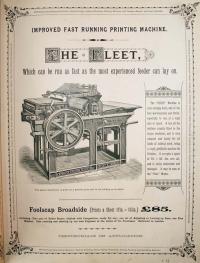
Source: Harrild & Sons Printing Machinery, Graphic Arts Collection, Princeton University Library

Example of a Harrild Albion press Source: Flagstaff Hill Maritime Museum and Village
There’s a lot to learn from the stories and connections behind Mary Seacole’s book. In some ways, they reflect something about Seacole herself – a combination of different backgrounds and expertise that all came together to make a huge success.
There are other aspects of her writing as well: her self-determination and entrepreneurism might have gone against certain prescribed standards of behaviour for women at the time, but writing her autobiography provided a way of fighting back against racist stereotypes and giving another much needed account of a significant historical event. It placed her, a proudly multiracial Caribbean woman amongst the ranks of widely read European lady travellers (examples include Isabella Bird, Mary Kingsley, Gertrude Bell) of the time and of course it gives us today another perspective on the important role of print for people from all backgrounds.
Getting access to our collections
As the custodians of a collection spanning 500 years, the Norwich Printing Museum is always looking for new ways to tell these stories. If you know about or are looking for potential connections with the history of print, why not get in touch? We are always happy to provide access to our collections.
